

Embarking on a real estate career in Florida's dynamic market is an exceptional professional endeavor. Success, however, begins with a well-defined strategy.
Fortunately, the pathway to licensure is clear and structured. The process involves state-mandated education, passing a comprehensive licensing exam, and—most critically—aligning with a brokerage that provides the resources necessary for long-term success. On average, a dedicated individual can transition from an aspiring professional to a licensed real estate agent in approximately two to three months.
Your Florida Real Estate Career Starts Here
View this journey not merely as a job change, but as the launch of your own enterprise. A career in real estate offers significant income potential and a level of professional autonomy many seek. Whether this is your inaugural career or a strategic professional shift, your unique life experience, communication skills, and local network are invaluable assets for a new agent.
Florida's real estate market is a global hub, attracting investment from around the world. This is not a temporary phenomenon; the global residential real estate market is projected to reach an astounding US$673.08 trillion by 2026, with the United States representing a substantial portion of this growth. You can explore the global real estate market trends to understand the full scope of this opportunity.
Understanding The Florida Landscape
In high-demand regions like Palm Beach County, known for its luxury and waterfront properties, the opportunities are abundant. Beyond high-value listings, first-time homebuyers constitute a consistent 28% of all purchases, representing a vital market segment for agents prepared to offer expert guidance. With mortgage rates stabilizing and inventory increasing, forecasts indicate a significant rise in home sales—an ideal environment for launching your career.
A successful real estate career is built on a foundation of solid education, strategic planning, and most importantly, the right mentorship. It's not just about getting a license; it's about building a sustainable business that can thrive in any market.
This guide serves as your definitive roadmap. We will deconstruct every step of how to become a real estate agent in Florida, covering the required 63 hours of pre-licensing education, detailing the state exam, and explaining how to select a brokerage like Coldwell Banker Premium Realty that is committed to your professional development from day one.
Before delving into the specifics, here is a concise overview of the licensing journey. Consider this a quick-reference summary of the key milestones you will achieve.
Florida Real Estate Agent Licensing At-A-Glance
| Requirement | Details | Estimated Timeline |
|---|---|---|
| Basic Eligibility | Be at least 18 years old, possess a high school diploma or its equivalent. | N/A |
| Pre-Licensing Course | Complete the 63-hour FREC-approved Sales Associate course. | 2-4 weeks (self-paced) |
| State Application | Submit your application and electronic fingerprints to the Department of Business and Professional Regulation (DBPR). | 2-4 weeks for approval |
| State Exam | Pass the 100-question multiple-choice examination with a score of 75% or higher. | 1-2 weeks to schedule |
| Find a Brokerage | Interview and affiliate with a brokerage to activate your license. | 1-3 weeks |
| Total Estimated Time | From initial steps to active licensure. | 2-3 Months |
This high-level overview helps contextualize the process as a series of manageable, sequential steps rather than a single, formidable task. Now, let us examine each of these requirements in greater detail.
Navigating Florida's Licensing and Exam Process
Your first official step on this new career path is navigating the state's licensing requirements. While it may appear complex, this process establishes the foundational legal and ethical knowledge that will define you as a credible, professional agent.
The journey begins with mandatory pre-licensing education.
More than a mere formality, the 63-hour pre-licensing course serves as your comprehensive introduction to Florida real estate. The curriculum provides an in-depth exploration of state-specific laws, real estate principles, contracts, property rights, and financing. The selection of a quality educational provider is paramount. Seek an institution approved by the Florida Real Estate Commission (FREC) that accommodates your learning style, whether through flexible online modules or a traditional classroom environment.
Upon completing the coursework, you will formalize your candidacy with the Florida Department of Business and Professional Regulation (DBPR). This involves submitting a formal application, which initiates a mandatory background check. You will need to provide electronic fingerprints at a state-approved vendor to verify your eligibility for licensure.
To provide a clear visual representation of the path ahead, the following flowchart outlines the entire process.
As illustrated, passing the state exam is a critical milestone, but the final step is activating your license by affiliating with a sponsoring brokerage. Only then can you legally begin representing clients.
Preparing for the Florida Real Estate Exam
With your application approved, your focus should shift entirely to preparing for the state exam. This is a 100-question, multiple-choice test, requiring a minimum score of 75% to pass. A disciplined approach is essential, as the questions are designed to assess your ability to apply knowledge to practical, real-world scenarios.
Successful candidates often employ a multi-faceted study strategy:
- Review Core Course Material: Revisit your pre-licensing coursework, focusing on areas where you felt less confident until they are fully mastered.
- Utilize Practice Exams: This is a non-negotiable step. Taking multiple practice exams simulates the timing and format of the official test and effectively identifies knowledge gaps.
- Form a Study Group: Collaborating with a study partner or small group can be highly effective. Articulating complex concepts to others reinforces your own understanding and exposes you to different perspectives.
On the day of the exam, arrive at the Pearson VUE testing center early to minimize stress. You will need to present two forms of valid identification. Once you begin, read each question methodically and manage your time effectively. If a question proves difficult, mark it for review and proceed, returning to it later. Trust in your preparation.
For experienced agents relocating to Florida, the licensing process may differ. It is crucial to understand the specific requirements for reciprocity or equivalency. We detail these steps in our guide for agents transitioning from NY or NJ to Florida.
Understanding the Initial Investment
A clear understanding of the initial financial commitment is crucial for proper planning. While the investment to launch a real estate business is reasonable compared to other industries, careful budgeting is essential. Managing your finances effectively at the outset allows you to concentrate fully on your studies and career launch without undue financial pressure.
Your initial investment is not just a cost; it's the seed money for your future business. Budgeting for these expenses is the first professional habit you'll build as an entrepreneur.
The following table provides a realistic estimate of the costs associated with obtaining your license. These figures may vary slightly based on your choice of school and other factors.
| Expense Item | Estimated Cost Range |
|---|---|
| 63-Hour Pre-Licensing Course | $200 – $500 |
| State License Application Fee | ~$84 |
| Electronic Fingerprinting Fee | $50 – $80 |
| State Exam Fee | ~$37 |
| Total Estimated Initial Cost | $371 – $701 |
This table outlines the direct licensing costs. However, you must also budget for subsequent professional expenses, including membership dues for your local REALTOR® association and the Multiple Listing Service (MLS). Once these requirements are met, you will be prepared for the most pivotal decision of your new career: selecting the right brokerage to foster your growth.
Choosing a Brokerage That Invests in Your Success
You have successfully earned your license. Congratulations. Now you face the single most consequential decision of your real estate career: selecting the right brokerage to sponsor your license.
This choice forms the bedrock of your business and can significantly influence your trajectory, determining whether you thrive or merely survive your inaugural year.
Do not view this as simply finding a place to hang your license. You are seeking a strategic partner—an organization as invested in your professional growth as you are. For a new agent, a robust support system that includes practical training, authentic mentorship, and a collaborative culture is non-negotiable.

Approach this process as if you are the hiring manager. You are interviewing brokerages to determine which one offers the tangible value needed to build your business, beyond just a recognizable brand.
Beyond the Commission Split: What Really Matters
While the commission split is an important consideration, it is only one component of a larger value proposition. A high commission split at a brokerage that offers minimal support is a poor long-term strategy. Operating without guidance is a slow, frustrating, and often costly way to learn this business.
Instead, prioritize the systems, resources, and support that directly contribute to your income-generating potential.
Market trends confirm the importance of robust support systems. The top 10 brokerage firms in the U.S. now command 27.2% of the sales volume, a significant increase from 14.3% in 2017. In a competitive market like Palm Beach County, a brokerage like Coldwell Banker Premium Realty offers new agents competitive splits that scale with production, without imposing ancillary monthly fees. This structure allows you to invest in your business, not just your broker's. You can delve into the brokerage consolidation trends to see how this is reshaping the industry.
"Don't just look for a place to hang your license. Look for a place to build your career. The best brokerages act as business accelerators, providing the tools, training, and culture you need to succeed faster."
A brokerage with in-house services, such as mortgage and title, provides a significant competitive advantage. For example, having these resources integrated at Coldwell Banker Premium Realty helps streamline transactions, often making the closing process 15-20% faster than is typical. For your clients, this translates to a smoother, more positive experience, which in turn generates positive reviews and referrals for your business.
Asking the Right Questions During Brokerage Interviews
When meeting with a potential broker, arrive with a prepared list of incisive questions. Your inquiries should go beyond surface-level promises to reveal the specific support structure they provide for new agents. Vague responses should be considered a red flag.
Here are the essential questions you should be asking:
- What does your new agent training program really look like? Request a detailed curriculum or schedule. Is it a brief orientation, or an ongoing, comprehensive program covering contracts, prospecting, and technology?
- How does your mentorship program work? Will I be assigned a dedicated mentor? How frequently will we meet? A hands-on mentor who is invested in your success is an invaluable asset.
- What kind of lead generation support do you provide? Do they offer a modern CRM? Do they provide company leads, or do they focus on teaching you to generate your own?
- Can I speak with a few agents who joined in the last six months? Speaking with recent hires is the most effective way to gain an unfiltered perspective on the brokerage's culture and the reality of its support systems.
This is also your opportunity to assess the office culture. Is it collaborative and energetic, or competitive and isolating? At our Coldwell Banker Premium Realty office in Lake Worth Beach, owners Dean and Tania Artenosi maintain an open-door policy. This fosters an environment where questions are encouraged and challenges are addressed collaboratively—a significant benefit for agents, especially those transitioning from other markets who need to quickly acclimate to Florida's local practices.
Choosing the right brokerage is a personal decision, but a structured evaluation will help you make an informed choice. This checklist highlights the key areas that will directly impact your income and long-term career success.
Brokerage Comparison: What Really Matters for Your Career
| Key Factor | What to Look For | The Coldwell Banker Premium Realty Advantage |
|---|---|---|
| New Agent Training | An ongoing, structured program covering contracts, marketing, and local practices—not just a one-day orientation. | We provide a comprehensive, hands-on training calendar that goes beyond the basics to cover real-world scenarios and income-producing activities. |
| Mentorship Program | A dedicated, experienced mentor who is incentivized to help you succeed and provides regular one-on-one guidance. | Our mentorship program pairs you with a top-producing agent who is a dedicated guide, ensuring you're never left to figure things out alone. |
| Lead Generation | Access to a modern CRM, company-provided lead opportunities, and practical training on how to build your own pipeline. | We provide a powerful CRM and a steady stream of company leads, plus teach you the prospecting skills to build a sustainable business. |
| Technology & Tools | A professional agent website, marketing automation tools, and transaction management software included at no extra cost. | Our agents get a full suite of cutting-edge tools, from a custom website to social media marketing systems, all included. |
| Culture & Support | A collaborative, non-competitive environment with direct access to brokers and leadership for questions and strategy sessions. | We foster a true "family" atmosphere with an open-door policy. Our brokers are always available to help you navigate complex deals. |
| Brand Recognition | A name that opens doors and inspires immediate trust and credibility with potential clients in your local market. | As a globally recognized and respected brand for over 100 years, Coldwell Banker gives you instant credibility from day one. |
| Fee Structure | A transparent fee structure with no hidden monthly "desk fees" or "technology fees" that eat into your profits. | We believe in a partnership model. Our commission plans are competitive and grow with you, with no hidden monthly fees. |
By utilizing this checklist, you can move beyond superficial sales pitches and identify a brokerage that is genuinely equipped and motivated to help you build a thriving career.
Finding a Brokerage That Fits Your Goals
Ultimately, the ideal brokerage is one whose values, culture, and resources align with your personal and professional objectives.
If you intend to begin on a part-time basis, you require a brokerage that offers flexible training schedules and accessible support. If your ambition is to penetrate the luxury market, you must align with a brand that has an established and powerful presence in that sector.
Remember that your unique life experience is a significant asset. Many successful agents begin their careers later in life, leveraging exceptional communication skills and extensive personal networks. Never underestimate the value of these established relationships.
Finally, evaluate the technology provided. A modern brokerage should equip you with a professional website, a robust CRM for database management, and effective social media marketing tools. These systems are the engine of a contemporary real estate business, enabling you to stay organized and convert leads at a rate far exceeding the industry average of 4.7%.
Making the right choice at this stage will set the foundation for a profitable and sustainable career for years to come.
Your First 90 Days: A Blueprint for Launching Your Career
Obtaining your real estate license is not the finish line; it is the starting point. The first three months in the business are formative and will set the tone for your entire career. This is not a time for passive waiting; it is a time for actively building the habits, systems, and momentum that create a sustainable business.
Conceptualize these first 90 days as three distinct sprints, each with a clear, strategic focus. By deconstructing your launch into manageable 30-day intervals, you transform the overwhelming task of starting a new career into a series of achievable daily objectives. This structured approach prevents aimlessness and ensures your efforts are consistently directed toward income-producing activities.
Days 1-30: Laying the Foundation
Your first month is dedicated to establishing your business infrastructure. This foundational, behind-the-scenes work is critical for enabling all future success. Before you can effectively prospect or serve clients, your operational systems must be firmly in place.
The top priority is to build and organize your database within a Customer Relationship Management (CRM) system. This is your business's most valuable asset.
- Consolidate Your Contacts: Aggregate every contact from your phone, email, and social media networks into a single master database. Aim for an initial list of at least 100-200 individuals.
- Categorize Your Sphere of Influence: Do not simply import contacts. Segment them logically. Identify your strongest advocates (close friends, family), potential clients, and professional contacts who can provide referrals.
- Master Your CRM: Dedicate time daily to learning the features of the CRM provided by your brokerage. This tool will serve as your command center for managing leads, tracking communication, and automating outreach.
During this phase, you should also immerse yourself in all available training. At Coldwell Banker Premium Realty, new agents are integrated into our ecosystem through world-class programs from Coldwell Banker University, weekly sales meetings, and one-on-one mentorship. The objective is to absorb as much practical, real-world knowledge as possible.
Days 31-60: Engaging and Gaining Visibility
With your foundation established, month two is focused on proactive engagement and visibility. You are transitioning from planning to action. Your goal is to establish yourself as a known, trusted real estate resource within your community.
Open houses should become a key part of your strategy. They are one of the most effective methods for meeting active buyers and sellers face-to-face. Volunteer to host open houses for experienced agents in your office; this creates a mutually beneficial arrangement where you gain invaluable experience and client-facing opportunities.
Your network is your net worth. Every single conversation is a chance to add value and build a relationship. Focus on being a helpful resource, not just a salesperson, and the business will naturally follow.
This is also the ideal time to activate your professional social media presence. Begin sharing genuinely useful content about the local market, offering tips for homeowners, and highlighting community events. The objective is not a direct sales pitch, but rather to establish yourself as the go-to local expert whom people know, like, and trust.
Days 61-90: Accelerating and Converting
The final 30 days of your launch plan are about acceleration. You have built your systems and initiated lead generation; now it is time to convert that activity into client appointments and, ultimately, your first closing. This is where diligent and consistent follow-up yields results.
A quality mentorship program proves its immense value at this stage. Effective training is vital, particularly as AI tools—a market projected to grow from $222.65 billion to $303.06 billion—automate top-of-funnel activities, requiring agents to master the human-to-human connection. In Florida, where a significant 28% of buyers are first-timers, a brokerage like Coldwell Banker Premium Realty provides a structured 90-day plan that helps new agents close 5-7 deals in their first few months, a substantial increase over the industry average of 2-3.
At this stage, your daily activities should be focused on consistent execution:
- Time-Block Your Calendar: Adhere strictly to a schedule. Allocate specific, non-negotiable blocks of time each day for prospecting, follow-up, and client appointments.
- Practice Scripts and Dialogues: This is not about sounding robotic; it is about being prepared. Role-play common client questions and objections with your mentor. Confidence is a direct result of preparation.
- Navigate Your First Transaction: Rely heavily on your broker and mentor for guidance as you manage your first client from contract to closing. Do not attempt to navigate this complex process alone.
Successfully executing this 90-day blueprint requires discipline and a robust support system. The hands-on guidance from experienced owners like Dean and Tania Artenosi at the Lake Worth Beach office ensures new agents receive real-time assistance to secure listings and close transactions. For more insights, explore our article on the support new agents actually need to succeed.
Mastering Prospecting and Building Your Client Base
A real estate license remains an abstract credential until you have clients to serve. The engine that drives your business and transforms that license into a viable career is consistent, disciplined lead generation. This is not about a single piece of software or a secret script; it is the daily work of building relationships and connecting with people.
The most successful agents master a few core prospecting methods that align with their personality and execute them with relentless consistency.
Tap Into Your Sphere of Influence
As a new agent, your most powerful and often overlooked asset is your Sphere of Influence (SOI). This network includes everyone who already knows, likes, and trusts you: friends, family, former colleagues, neighbors, and other personal acquaintances. You have spent a lifetime cultivating these relationships; now is the time to inform them of your new professional capacity.
This is not about aggressive sales tactics. It is about transitioning your role from "friend" to "friend who is a trusted real estate resource." Share valuable market data, offer a complimentary home valuation, or simply check in. Your primary goal is to remain top-of-mind, ensuring you are the first person they think of when real estate needs arise for them or someone they know.
Build a Strong Community Presence
Real estate is fundamentally a local business. The more visible and connected you are within your community, the more opportunities will naturally come your way. It is essential to engage with people face-to-face, beyond digital interactions.
- Attend Local Events: Join the local chamber of commerce, participate in charity fundraisers, or volunteer for a cause you support. These activities allow you to meet new people in a low-pressure, organic environment.
- Host Valuable Seminars: Partner with a local mortgage lender to host a free workshop for first-time homebuyers. This positions you as an expert and connects you with a room full of motivated, qualified leads.
- Support Other Local Businesses: Cultivate professional relationships with local attorneys, CPAs, and contractors. A strong referral network is a reciprocal relationship that can become a consistent source of business.
Prospecting isn’t a task you check off a list; it’s a daily habit. The top agents I’ve mentored build their entire day around these income-producing activities, making sure their pipeline is never empty.
Becoming a recognized and helpful figure in your community is how you build a long-lasting business. This relationship-first philosophy is a core tenet of our culture at Coldwell Banker Premium Realty. We understand that sustainable careers are built on trust, not just transactions. Building these local connections is particularly vital when assisting with real estate relocation.
Convert Open House Visitors Into Clients
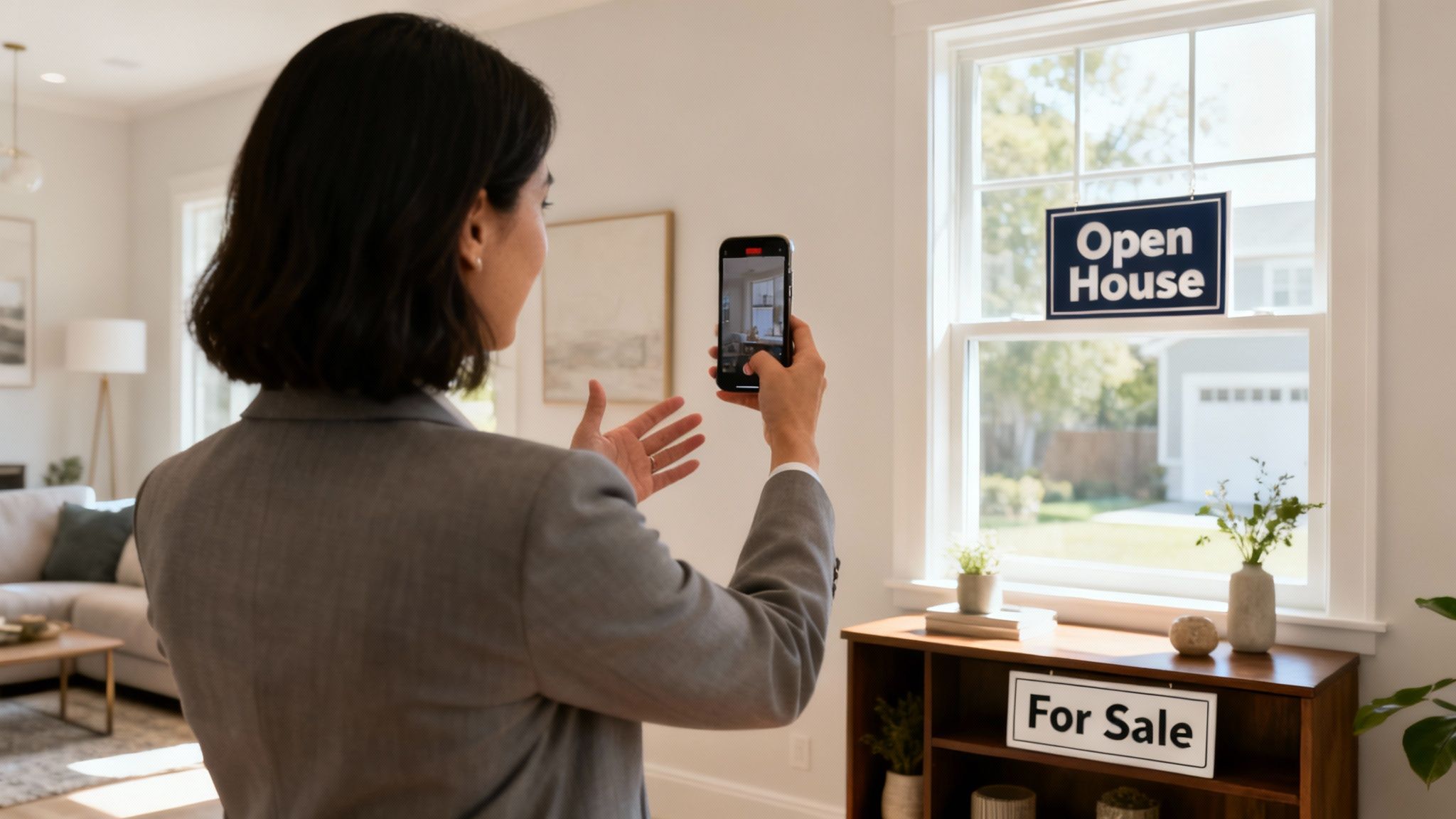
An open house is far more than an opportunity to sell a single property; it is a prime lead-generation event. With a strategic approach, you can leave each open house with multiple new buyer and seller leads.
Shift your mindset from that of a door-opener to the host of an event. Greet every visitor warmly, ask intelligent questions about their property search, and position yourself as the definitive source of information on the home, the neighborhood, and the current market.
A professional sign-in process is non-negotiable. Use a digital form on a tablet to efficiently capture names, phone numbers, and emails. This facilitates a systematic and professional follow-up process—and it is this follow-up that converts a casual visitor into a committed client.
Create a Powerful Online Brand
In the digital age, your online presence functions as your 24/7 professional storefront. When a potential client hears your name, their first action will be an online search. The results of that search should convey professionalism, expertise, and approachability. Social platforms like Instagram and Facebook are ideal for cultivating this brand.
However, your content strategy should extend beyond simply posting listings. Share content that provides genuine value to your audience.
- Market Updates: Record brief videos explaining local inventory trends or changes in mortgage rates.
- Neighborhood Tours: Act as a local guide. Showcase the best parks, restaurants, and unique features of the communities you serve.
- Homeowner Tips: Offer practical advice on topics like home maintenance or staging. This establishes your credibility and demonstrates your expertise.
This value-driven content strategy builds your authority and attracts an audience genuinely interested in real estate. At Coldwell Banker Premium Realty, we provide our agents with a competitive advantage through social media marketing tools like Back At You Media, which simplifies the creation and distribution of professional content that enhances visibility. A consistent, value-first approach is a cornerstone of how you become a real estate agent who thrives for years to come.
Your Top Questions, Answered
Embarking on a new career path naturally raises many questions. To provide clarity, let's address some of the most common inquiries from aspiring real estate agents so you can have a clear, realistic understanding of what to expect.
How Much Does It Really Cost to Get Started in Florida?
This is a primary concern for many. While state licensing fees are relatively modest, it is essential to budget for the complete launch of your business. Realistically, you should plan for startup costs in the range of $1,000 to $2,500.
This figure encompasses your 63-hour pre-licensing course, state application and exam fees, and fingerprinting. The largest portion of this budget will typically be allocated to your initial REALTOR® association and MLS dues.
Beyond these initial costs, I advise every new agent to have a financial reserve of three to six months of living expenses. A commission-based income offers great potential but can be unpredictable at first. A strategic decision, such as joining a brokerage like Coldwell Banker Premium Realty that does not charge monthly office fees, provides a significant advantage by helping you control overhead and retain more of your earnings as you establish your business.
Can I Start Part-Time While Keeping My Current Job?
Yes, this is a viable and common strategy. Many successful agents begin their careers this way, building their client base while maintaining the security of a steady income.
The key to this approach is meticulous time management. You must be available for showings and client appointments, which frequently occur during evenings and weekends. This is where aligning with the right brokerage becomes critical. You need a supportive team that understands and accommodates this flexibility. Access to on-demand training and a mentor who is available for quick consultations are what enable part-time agents to build significant momentum.
What's the Single Most Important Factor for a New Agent's Success?
Unequivocally, it is the choice of brokerage. While consistent prospecting is essential, the right brokerage acts as a career accelerator. It provides the structured training, one-on-one mentorship, and supportive culture that can significantly shorten your learning curve.
Choosing a brokerage is the difference between being given a roadmap and being told to find your own way in a new industry. Access to experienced leadership helps you solve problems in real-time and builds the confidence needed to close deals.
This support system bridges the gap between theoretical knowledge learned in a licensing course and the practical skills required to generate income and build a lasting career.
How Long Does It Take to Close That First Deal?
The timeline varies, but with a solid plan and excellent support, most new agents close their first transaction within three to six months. This can be expedited by engaging in a structured program, such as a 90-day success plan, that focuses your energy on income-producing activities from day one.
Consistency is paramount. Your first client will most likely come from your existing network. Therefore, as soon as your license is active, begin communicating your new career path. Diligent, professional follow-up is what will convert those initial conversations into your first closing.
Ready to build a profitable and sustainable real estate career with a brokerage that invests in you? At Coldwell Banker Premium Realty, we provide the mentorship, training, and support you need to succeed from day one. Learn more about joining our team at https://join.cbpremiumrealty.com.
Article created using Outrank
0 comments