

Choosing the right real estate brokerage is one of the most consequential decisions you will make for your professional journey. This choice will directly shape your income potential, skill development, and ultimately, your long-term satisfaction in the real estate industry. The optimal brokerage is always the one that aligns with your unique career goals—whether you are a newly licensed agent requiring comprehensive mentorship or a seasoned professional poised for expansion.
Your Blueprint for Finding the Right Brokerage
Deciding where to affiliate your license is far more than a logistical formality; it is the very foundation upon which you will build your entire real estate business. A well-aligned choice can significantly accelerate your growth trajectory. Conversely, a poor fit can lead to frustration, stalled progress, and unnecessary challenges. This guide is professionally designed to help you look beyond the glossy recruitment brochures and delve into the factors that truly matter for your success.

Caption: A strategic brokerage evaluation begins with a personal scorecard to weigh each firm against your specific career priorities and needs.
Start with a Personal Career Assessment
Before you schedule a single interview with a broker, it is imperative to conduct a thorough self-assessment. Your specific needs and professional objectives are the most critical variables in this equation. This internal review will help you create a personalized scorecard to measure every potential brokerage against your priorities.
To begin, identify which of these professional profiles most accurately describes your current situation:
- The Newly Licensed Agent: Your focus is likely on securing structured training, practical mentorship, and a clear, actionable path to closing your first few transactions. You need a supportive, nurturing environment that helps you build both confidence and essential field skills.
- The Experienced Producer: You possess a solid track record but are now seeking a more advantageous commission split, superior lead-generation systems, or robust administrative support to break through to the next level of production.
- The Relocating Agent: Your primary objective is to integrate into a new market rapidly. You require a brokerage with a powerful local reputation, an established referral network, and the resources to help you build a client base from scratch in an unfamiliar territory.
Balancing Splits, Fees, and Real Value
It is incredibly easy to become fixated on the commission split, but this single number rarely provides the full financial picture. A brokerage advertising a 90% split may seem highly attractive on paper, but that appeal can diminish quickly once you account for high monthly desk fees, technology charges, and mandatory marketing costs that erode your actual net income.
The most important financial metric is not the gross commission split; it is the net amount deposited into your bank account after all brokerage-related fees are paid. A lower split at a firm that provides high-quality leads and covers all marketing expenses can easily prove to be more profitable.
Conversely, a financial model with zero monthly fees offers valuable financial predictability, which can be a significant advantage when you are establishing your business. We will explore these financial models in greater detail in the following sections.
For those at the beginning of this professional path, obtaining a complete overview is crucial. You can find a detailed breakdown of the initial steps in our comprehensive guide on how to become a real estate agent. Consider it your foundational resource for building a successful career from day one.
Navigating Commission Splits and Financial Models
Let's conduct a detailed analysis of the financial components. While compensation is a significant piece of the puzzle, the commission split presented in recruitment materials rarely tells the complete story. The real estate industry features a variety of financial models, and it is essential to look beneath the surface to determine which one aligns with your financial objectives.
Your primary task here is to move beyond the prominent percentage figure and uncover the complete economic reality of partnering with a given brokerage.
That seemingly advantageous 90/10 split can appear to be a clear winner, but it often comes with significant caveats. High-split models are frequently associated with substantial monthly desk fees, mandatory marketing contributions, technology access charges, and a range of other recurring expenses. These costs can significantly reduce your take-home pay, particularly during slower market periods.
Deconstructing Common Brokerage Financial Models
To make an informed decision, you must understand the different ways brokerages generate revenue. Each model is structured to attract a specific type of agent, from the high-producing veteran who requires minimal support to the brand-new agent who needs extensive guidance.
Here are the primary models you will encounter:
- Traditional Split Model: This is often a tiered system where your commission split improves as your sales volume increases. You might begin at a 60/40 split, and as your production reaches certain benchmarks, you could "cap" out and transition to a 100% commission for the remainder of your anniversary year.
- 100% Commission Model: This model is straightforward—you retain the full commission but pay the brokerage a flat monthly fee and often a per-transaction fee. This is highly attractive to seasoned, high-volume agents with a consistent flow of business who can comfortably cover the fixed overhead.
- No Monthly Fee / All-In Split Model: This is a more contemporary approach where the brokerage covers most core operational costs—such as E&O insurance, your CRM, and marketing platforms—in exchange for a set commission split. It offers new agents predictable finances and removes the constant pressure of monthly overhead.
Your objective is to calculate your true 'net split'—the actual percentage of your gross commission that you retain after every single fee has been deducted. This is the only figure that allows for a genuine apples-to-apples comparison between brokerages.
Beyond the Split: Uncovering Hidden Costs
The advertised split is merely the tip of the iceberg. A prudent evaluation involves a deep dive into the fee structure to ascertain your true costs. These expenses are often detailed in the fine print of the independent contractor agreement, so it is essential to request a comprehensive breakdown.
Ensure you receive clear and definitive answers regarding these common expenses:
- Desk or Office Fees: A monthly charge for affiliation with the office, which may apply regardless of whether you use a physical desk.
- Technology Fees: Covers access to the CRM, agent website, transaction management software like Dotloop, and other digital tools.
- Errors & Omissions (E&O) Insurance: This may be structured as an annual lump-sum payment or as a deduction from each commission check.
- Marketing Fees: Some brokerages require a monthly contribution to a general marketing fund.
- Franchise Fees: A percentage (often 5-8%) deducted from the top of your gross commission for affiliation with a national brand.
- Transaction Coordinator Fees: A per-deal charge for administrative staff to manage your paperwork, which can be either mandatory or optional.
A Real-World Financial Comparison
To illustrate how these factors impact your earnings, let's examine a practical example. Consider two agents, both projected to earn $100,000 in Gross Commission Income (GCI) for the year, but affiliated with two distinctly different brokerages.
To simplify the comparison, let's organize these figures into a table.
Brokerage Financial Model Comparison
The table below provides a detailed breakdown of three common financial structures to demonstrate how the same $100,000 in GCI can yield vastly different net incomes for the agent. This is a hypothetical scenario based on completing 10 transactions over the course of the year.
| Financial Item | Model A (High Split / High Fees) | Model B (Tiered Split / Medium Fees) | Model C (No Monthly Fees / All-In Split) |
|---|---|---|---|
| Agent Gross Commission (GCI) | $100,000 | $100,000 | $100,000 |
| Commission Split | 90/10 | 80/20 (Caps at $20k) | 70/30 (No Cap) |
| Monthly Fees | |||
| Desk/Office Fee | $1,000/mo ($12,000/yr) | $100/mo ($1,200/yr) | $0 |
| Tech Fee | $200/mo ($2,400/yr) | $50/mo ($600/yr) | $0 |
| Per-Transaction Fees | |||
| Transaction Fee | $500/deal ($5,000/yr) | $250/deal ($2,500/yr) | $0 |
| Franchise Fee (6%) | $6,000 | $6,000 | $0 |
| Calculations | |||
| Brokerage Split Paid | $10,000 | $20,000 (Capped) | $30,000 |
| Total Fees Paid | $19,400 | $4,300 | $0 |
| Total Paid to Brokerage | $35,400 | $30,300 | $30,000 |
| Agent's Final Net Income | $64,600 | $69,700 | $70,000 |
As this analysis demonstrates, the "best" split on paper (Model A) actually resulted in the lowest net income once all fees were accounted for. The agent at Model C, who assumed zero monthly financial risk, ultimately retained the most capital. For a new agent, the predictable, all-inclusive model is often far less stressful and allows them to concentrate on business-building activities rather than simply covering overhead.
Evaluating Mentorship, Training, and Professional Growth
For a moment, set aside the commission split. The single most powerful factor in building a long-term, profitable real estate career is professional development. This extends beyond initial licensing—it encompasses having the robust support system necessary to effectively utilize that license.
Exceptional training and accessible, high-quality mentorship are not mere perks for new agents; they are the bedrock of consistent growth and the key to navigating a competitive, ever-evolving market. The right brokerage invests in your professional development, understanding that your success is intrinsically linked to their own.
This investment manifests in various forms. It may include a structured online learning platform, but more critically, it involves one-on-one guidance from a hands-on broker who is available when a transaction encounters difficulties. Learning to distinguish between a brokerage with a passive "training library" and one that offers true, actionable mentorship is a critical evaluation step.
What Robust Agent Onboarding Looks Like
For a newly licensed agent, the initial 90 days are pivotal. A strong onboarding program must provide a clear, repeatable roadmap from day one to the first closing and beyond. The objective is to build foundational skills and the confidence required to execute business-generating activities.
An effective program avoids theoretical fluff and concentrates on practical, income-producing activities. Look for brokerages that deliver structured support in these key areas:
- Client Prospecting and Lead Generation: Actionable scripts, daily business routines, and hands-on guidance for building your sphere of influence and converting leads into clients.
- Contract Negotiation and Writing: Real-world workshops focused on drafting clean, compelling offers and counter-offers that protect your clients' interests and secure deals.
- Closing Procedures and Timeline Management: Step-by-step training on navigating the entire transaction lifecycle, from contract execution to closing, ensuring a seamless experience for all parties.
- Local Market Expertise: In-depth analysis of neighborhood trends, advanced pricing strategies, and property types specific to your market, such as the unique dynamics of waterfront properties in Palm Beach County.
Differentiating Training from True Mentorship
A library of training videos is a useful resource, but it cannot provide a specific answer regarding a concerning inspection report at 7 PM on a Friday. This illustrates the core difference between passive training and active mentorship. One provides information; the other delivers wisdom and real-time problem-solving.
True mentorship means you have direct, reliable access to experienced leadership. It is having someone who can help you troubleshoot a specific transactional issue and provide the strategic coaching needed to break through to your next income level. It's about having a partner, not just a platform.
This hands-on support is what enables you to navigate your initial transactions with confidence. If you are seeking genuine guidance on structuring your business for long-term success, let's connect. You can book a free coaching call to discuss your personal growth plan with an experienced broker.
This chart illustrates how a brokerage that invests in your professional growth directly impacts your financial outcome. Enhanced support leads to a higher net income over time.
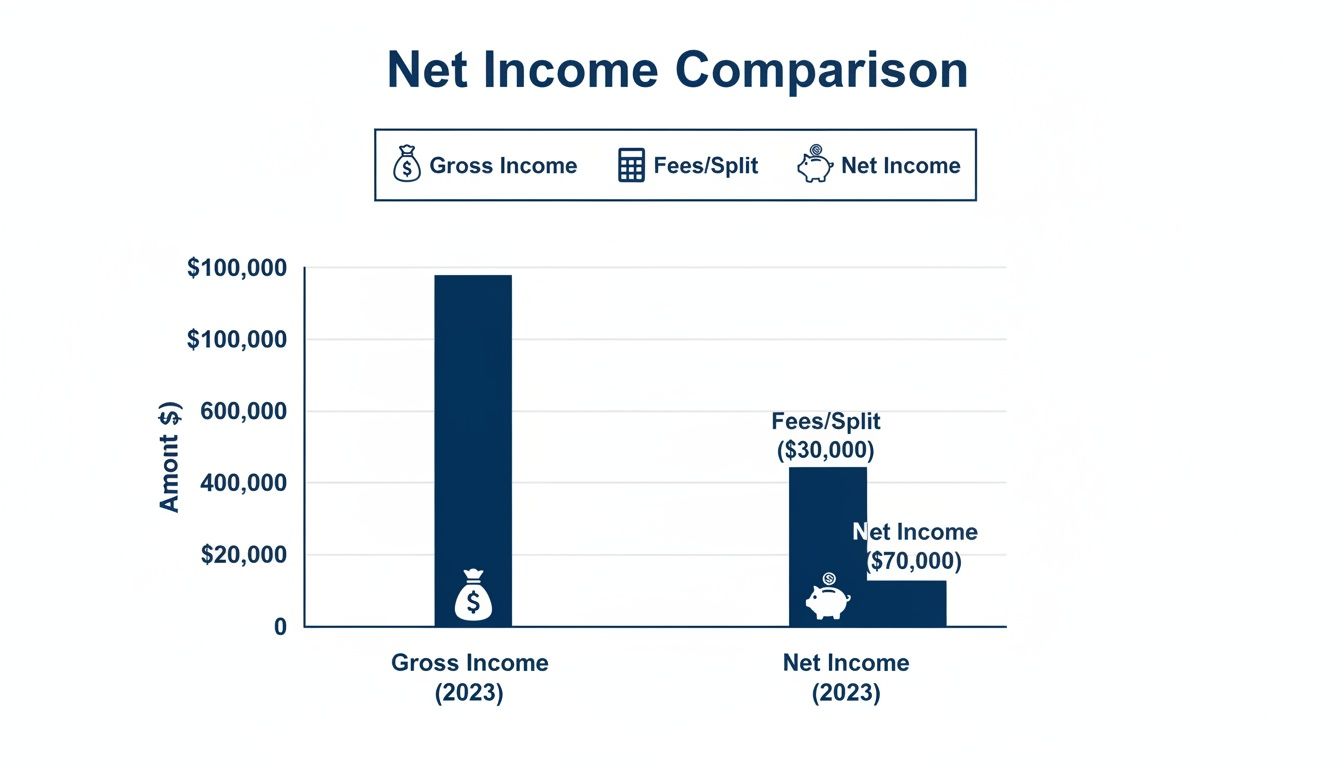
Caption: This infographic demonstrates that a focus on comprehensive support systems can boost net income more effectively than chasing a high commission split alone.
It’s clear: focusing on support systems that boost your productivity can lead to a healthier net income than simply chasing a high commission split with minimal backing.
Advanced Growth for Experienced Agents
Professional development does not conclude after the first year. For experienced agents, the right brokerage provides opportunities to specialize, scale, and increase efficiency. Your needs evolve from learning the fundamentals to mastering niche markets and leveraging your time more effectively.
Seek a brokerage that offers advanced training and resources aligned with your long-term ambitions. This could include:
- Luxury Market Certification: Specialized training on marketing high-end properties and serving the unique needs of an affluent clientele.
- Investment Property Analysis: Workshops on calculating ROI, understanding 1031 exchanges, and advising real estate investors.
- Technology Mastery: In-depth coaching on leveraging the brokerage’s tech stack to automate marketing, manage your database effectively, and generate more referrals.
- Team Building and Leadership: Strategic guidance for top producers who are ready to build their own team and create genuine leverage in their business.
Ultimately, choosing a brokerage is about selecting a business partner who is genuinely invested in your professional journey. A great training program builds your skills, but a great mentor helps you apply those skills to construct a thriving, sustainable career.
Analyzing a Brokerage’s Tech and Marketing Arsenal
In today's real estate landscape, your business operates on two fundamental engines: technology and marketing. The brokerage you select should function as a true partner, providing you with a powerful, integrated suite of tools—not just a disconnected collection of software subscriptions. The goal is not to chase the newest application, but to have a cohesive system that helps you work more efficiently, generate leads, and secure more listings.

Caption: An effective brokerage provides an integrated digital ecosystem, including a CRM, agent website, and marketing tools, to streamline an agent's workflow.
A top-tier brokerage offers an entire ecosystem where the technology stack and marketing support are seamlessly integrated. Your CRM should connect flawlessly with your website, and your social media scheduler should be pre-loaded with professionally designed, brand-compliant content ready for deployment. This synergy saves countless hours of administrative work, freeing you to focus on high-value, client-facing activities.
Evaluating the Core Technology Stack
When interviewing a brokerage, do not settle for a PDF listing software logos. Request a live demonstration of their technology platform. It is crucial to see exactly how these tools function together in a real-world context. A truly valuable tech stack is both powerful and intuitive, providing everything needed to manage your business from a single, centralized dashboard.
Here are the non-negotiable technology components a brokerage should provide:
- A Modern CRM: Your Customer Relationship Manager is the operational heart of your business. It must do more than store contacts; it should help you track leads, manage your client database, and automate follow-up campaigns. A superior CRM provides a clear, comprehensive view of your entire sales pipeline.
- Customizable Agent Websites: A professional online presence is essential. The brokerage should offer IDX-enabled websites that are easy to personalize, are fully responsive for mobile devices, and are engineered from the ground up for lead capture.
- Transaction Management Software: You need a digital command center for all paperwork. Tools like Dotloop or DocuSign are fundamental for managing contracts digitally. An integrated system streamlines the entire process, reduces errors, and ensures compliance.
- E-Signature Platforms: The ability to obtain electronic signatures is no longer a luxury; it is a basic client expectation. This technology accelerates transaction timelines and enhances the client experience for all parties involved.
The true measure of a brokerage's tech stack is not just what they offer, but how well the components are integrated. A cohesive system saves you from the inefficiency and frustration of managing multiple, disconnected platforms and subscriptions.
Assessing the Quality of Marketing Support
If technology is the engine, then marketing is the fuel that powers it. A brokerage’s marketing support can be the differentiating factor between constantly struggling for new leads and maintaining a predictable client pipeline. It is critical to discern between brokerages that merely provide generic templates and those that offer high-quality marketing assets designed to elicit a response.
A strong marketing program should actively assist you in building your personal brand while allowing you to leverage the power and recognition of the brokerage's established name. This support must be practical, professional, and easy to integrate into your daily business activities.
From Digital Tools to Tangible Results
Look for a brokerage that provides a complete suite of marketing resources. This support should encompass everything from digital campaigns to print materials, ensuring you can maintain a professional and consistent brand image across all client touchpoints.
Here’s what a robust marketing arsenal should include:
- Professionally Designed Marketing Materials: This includes high-caliber listing presentations, buyer guides, postcards, and brochures that you can easily customize with your photo and contact information. Quality is paramount—outdated or poorly designed materials reflect negatively on your professional brand.
- Social Media Automation and Content: Many agents find it challenging to maintain a consistent social media presence. Brokerages that provide a tool like Back At You Media, which can automatically publish relevant, high-quality content to your professional profiles, offer a significant time-saving advantage.
- Lead Generation Systems: It is essential to ask the direct question: "How, specifically, does the brokerage help its agents generate leads?" Do they provide company-generated leads? Are their websites and marketing tools equipped with effective, built-in lead capture functionalities? A proactive approach to lead generation is a clear indicator of a growth-oriented brokerage.
- Email Marketing Platforms: Maintaining top-of-mind awareness with your sphere of influence is vital for long-term success. The brokerage should provide an intuitive email marketing tool, ideally one that is already integrated with your CRM, so you can easily distribute market updates, new listing alerts, and newsletters.
Ultimately, when you are choosing a real estate brokerage, you are selecting a business partner. Their investment in technology and marketing is a direct investment in your capacity to succeed.
Finding the Right Culture and Leadership Fit
Beyond the commission splits and advanced technology, there is one factor that will profoundly influence your career trajectory and day-to-day professional happiness: the brokerage culture.
A positive cultural fit can create an environment that energizes your drive and helps you navigate challenging transactions. Conversely, a toxic or unsupportive office can drain your motivation and stall your progress, regardless of how favorable the financial terms may appear on paper.
When you select a brokerage, you are not just choosing a brand; you are choosing the people with whom you will collaborate daily. You are selecting your mentors, your colleagues, and your support system. Finding a professional home where you genuinely align with the company's values is not a "nice-to-have"—it is a fundamental business decision.
Collaborative vs. Cutthroat: How to Spot the Difference
During your interviews, your primary objective is to gain an authentic sense of the office environment. Is the energy collaborative, with agents openly sharing successes and advice? Or does it feel like a competitive, every-agent-for-themselves atmosphere? The difference will have a direct impact on your ability to learn and thrive.
Pay close attention to how the managing broker and other agents discuss success and achievement.
- Signs of a Healthy, Collaborative Culture: You will observe leadership actively and publicly celebrating agent accomplishments. Agents are encouraged to partner on deals, and there are regular mastermind sessions or group workshops dedicated to collaborative problem-solving.
- Red Flags of a "Shark Tank" Culture: The entire conversation is dominated by individual production rankings and leaderboards. You may notice a conspicuous lack of friendly interaction among agents. The broker might even appear to foster competition between agents.
A supportive brokerage operates on a core principle: a rising tide lifts all boats. When agents feel comfortable asking for assistance and sharing best practices, everyone's business improves as a result.
Is the Broker Actually Available to Help You?
One of the most critical aspects of a brokerage's culture is the accessibility of its leadership. When you encounter a complex contract question at 9 PM or face a difficult client situation, you need a broker who is responsive and willing to provide guidance.
Consider this: a broker who seems "too busy" to meet with you during the interview process will almost certainly be unavailable when you are facing a genuine professional challenge.
Inquire directly about their process for agent support. Will you have their direct mobile number? What is their typical response time? An engaged, hands-on leader is an invaluable asset who can help you navigate difficult situations and, more importantly, avoid costly errors. This level of direct support often distinguishes a large, impersonal firm from a more boutique, agent-centric brokerage.
Local Reputation Matters More Than You Think
A brokerage’s brand extends beyond a logo on a sign; it represents its reputation within the local community. A firm with deep roots and a positive standing in a specific market, such as Palm Beach County, provides its agents with a significant competitive advantage. This strong local presence translates to instant brand recognition, client trust, and a built-in referral network that could otherwise take years to establish.
The U.S. real estate brokerage market is substantial, valued at approximately $206.45 billion, with residential sales comprising a commanding 81% of that total. This vast market allows for the success of both large national brands and specialized local brokerages. Your task is to determine if a firm possesses the specific local expertise required for the unique properties in your target area, as this directly impacts your earning potential. You can explore these market dynamics in greater detail at Mordor Intelligence.
Ultimately, you are looking for a place that feels like a genuine professional home—an environment where you feel motivated, supported, and confident that the people around you are truly invested in your success.
A Decision Checklist for Every Agent
Your needs as a real estate agent are dynamic; they evolve with every transaction you close and every professional milestone you achieve. It is a simple truth that the ideal brokerage for you on day one is rarely the same one that will suit you in your tenth year of business.
Understanding this principle is the key to making a smart, strategic decision that aligns with your current career stage.
Therefore, instead of a generic, one-size-fits-all approach, let's examine what matters most based on your level of experience. This will help you filter out the noise and concentrate on the support systems that will genuinely foster your growth, rather than just the flashy perks that sound good in a recruitment pitch.
For the Brand-New Agent
Your primary mission is to build a solid foundation and successfully navigate your first closing. Your evaluation checklist should prioritize hands-on guidance and practical, real-world training.
- A Real Onboarding Plan: Is there a clear, step-by-step roadmap for your first 90 days?
- Help When You Need It: Can you reach your broker by phone tonight to get help with a contract question?
- Finding That First Client: Does the brokerage offer tangible, actionable assistance in generating your first leads?
- No Monthly Pressure: Can you focus on learning the business without the financial stress of monthly desk fees?
For the Experienced Pro
You have an established book of business and a proven track record. Now, your focus is on scaling up, increasing efficiency, and maximizing your profit on every transaction. You need a partner who can help you elevate your existing business, not hinder it.
- The Bottom Line: Does the commission split and fee structure truly maximize your net income? Perform a detailed financial analysis.
- Getting Your Time Back: Is a transaction coordinator available to manage paperwork and free you up for client-facing activities?
- Brand Power: Does the brokerage's sign in a yard help you win more listings before you even step through the door?
- Smarter Tech: Is the CRM and marketing automation robust enough to support a high-volume business, or is it merely basic?
For the Relocating Agent
When you enter a new market, you are essentially starting from square one—even with years of experience. Your absolute top priority is to integrate into the local real estate community and build a new network rapidly.
- Hyper-Local Knowledge: Is the brokerage a recognized leader in the specific towns and neighborhoods you aim to serve?
- A Strong Referral Pipeline: Does the company have a system in place to connect you with incoming leads and relocation clients?
- The Right Vibe: Is the office culture collaborative and welcoming? This is crucial for building essential local connections.
For agents relocating to Florida, our guide on transferring your NY/NJ real estate license is an essential resource.
The U.S. real estate market is vast, with an estimated 963,000 brokerage businesses projected by 2025. This landscape is not limited to large national players; it includes thousands of specialized, locally-focused firms where you can gain direct access to leadership and benefit from deep community roots. This diversity is your greatest advantage—it means the perfect fit for your business is out there. You can explore the U.S. real estate brokerage market in more detail to understand the full scope of opportunities.
Got Questions? We've Got Answers.
Choosing a brokerage is a significant decision, and you likely have numerous questions. Let's address some of the most common inquiries I receive from agents. My objective is to provide direct, honest answers to help you make a choice with confidence.
Is the Highest Commission Split Always the Best Deal?
In my professional experience, it is almost never the best overall deal. A 90% split appears highly attractive on a spreadsheet, but it rarely reflects the complete financial reality of what is deposited into your bank account.
Many high-split models function as a financial shell game. The brokerage often compensates by charging substantial monthly desk fees, technology fees, franchise fees, and mandatory marketing costs. I have seen agents achieve a higher net income with a lower split at a full-service brokerage simply because high-quality leads, E&O insurance, and a robust technology stack were all included. It is imperative to always perform a detailed financial analysis to determine your net income after every single fee is deducted.
How Much Does a Big National Brand Name Really Matter?
The importance of a national brand depends entirely on your career stage. For a newly licensed agent or someone relocating to a competitive market like Palm Beach County, a well-known national brand provides a significant shortcut to establishing credibility. Clients often feel a sense of security and trust with a name they already recognize. This can open doors.
Conversely, some of the top local boutique brokerages offer unparalleled one-on-one access to leadership and possess deep, authentic roots within the community. The right choice depends on your personal goals. Do you require the immediate trust associated with a major brand, or do you thrive in a smaller, more close-knit professional environment?
Red Flag Warning: Be wary of vague or evasive answers about fees, a training program that seems improvised, or a cutthroat, "every-agent-for-themselves" atmosphere. And here is a critical one: if the managing broker is too busy to give you their full, undivided attention during an interview, imagine how difficult they will be to contact when you have an urgent transaction issue.
Ready to join a brokerage that truly invests in your success? At Coldwell Banker Premium Realty, we offer direct mentorship, zero monthly fees, and the power of a global brand within a supportive, non-corporate culture. We provide the training, technology, and collaborative environment you need to build a lasting and prosperous business.
Let's have a confidential chat about your future.
Article created using Outrank
0 comments